Passionflower and the science of canine calm
28 January 2026•Natalie•3 min read
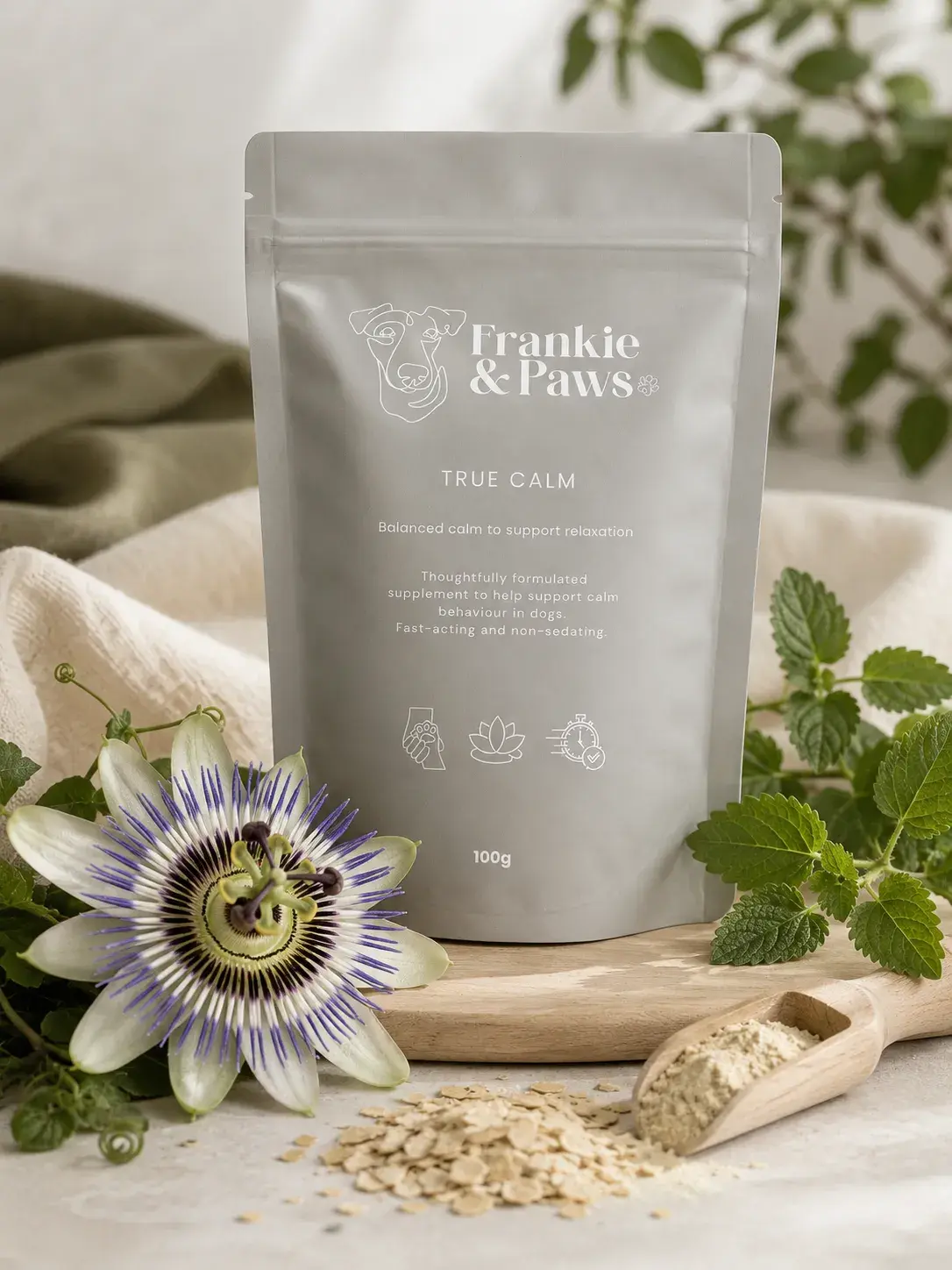
Passionflower (Passiflora incarnata) is the quiet workhorse of canine calm. It has been used in herbal medicine for centuries, but what makes it the lead ingredient in True Calm isn't tradition — it's the way it works on the nervous system. Gentle, predictable, and never sedating.
What passionflower actually does
Passionflower contains a family of flavonoids — chrysin, vitexin, and isovitexin among them — that modulate the GABA system. GABA is the brain's primary inhibitory neurotransmitter — the "brake pedal" the nervous system uses to dial things down when the world gets loud. Passionflower nudges that brake pedal gently, which is why dogs given it become noticeably more settled without becoming dopey, slow, or unresponsive. They can still hear their name, still come when called, still play. The hum of anxious signalling is what quiets, not the dog.
That gentle profile is the whole point. Prescription anxiolytics work on the same system but with much harder pharmacology — useful in their place, but a heavier intervention than most everyday situations call for. Passionflower sits comfortably below that threshold: enough to take the edge off fireworks, fireworks-night, car journeys and visitor stress, but light enough to give every day.
Why we pair it with L-Tryptophan and L-Tyrosine
Calm isn't only about slowing things down. It's about giving the brain the raw materials it needs to produce serotonin (mood) and dopamine (focus and reward). L-Tryptophan is the precursor to serotonin; L-Tyrosine is the precursor to dopamine and noradrenaline. Under sustained stress, dogs (like humans) deplete these amino acids faster than they can make them. Supplementing them gives the nervous system something to work with rather than asking it to run on fumes.
The effect is additive: passionflower damps the alarm response, the amino acids support the downstream recovery. You end up with a dog who's easier to live with on a fireworks night and more evenly-tempered the rest of the year.
Lemon balm, taurine, brewer's yeast
Lemon balm (Melissa officinalis) layers in a complementary GABAergic effect through rosmarinic acid and a small family of terpenes — belt and braces alongside passionflower for dogs who are particularly reactive. We use it as a 4:1 extract, the same grade used in peer-reviewed human research on mild anxiety, so a small daily scoop is enough.
Taurine — which you'll often see on cat food but rarely dog food — plays a quiet role in stabilising excitable nerve cells. And brewer's yeast is a nutritional ingredient: a natural source of B-vitamins that the adrenal system burns through under chronic stress. Together they form the supporting cast around the passionflower-led nervous-system blend.
What it isn't
True Calm is a complementary feed, not a medicine. It won't sedate a dog and it won't change fundamental behaviour patterns overnight. For situational stress — fireworks, car journeys, vet visits, delivery drivers at the door — give a dose 30 to 60 minutes before the trigger. For generalised anxiety, consistency is what does the work: a daily scoop over 2–3 weeks is when most owners notice a softer-shouldered, looser-tailed version of their dog that had been hiding underneath.
If your dog's anxiety is severe, self-harming, or interfering with eating and sleeping, please start with your vet — a supplement is an adjunct to good behavioural support, not a replacement for it.
Join the Frankie & Paws Family
Subscribe to our newsletter for research-led wellbeing guides and key ingredient insights, and enjoy 10% off your first purchase.