
Natural dog supplements in the UK: what they are, when they help and how to choose
11 January 2026•Natalie•9 min read
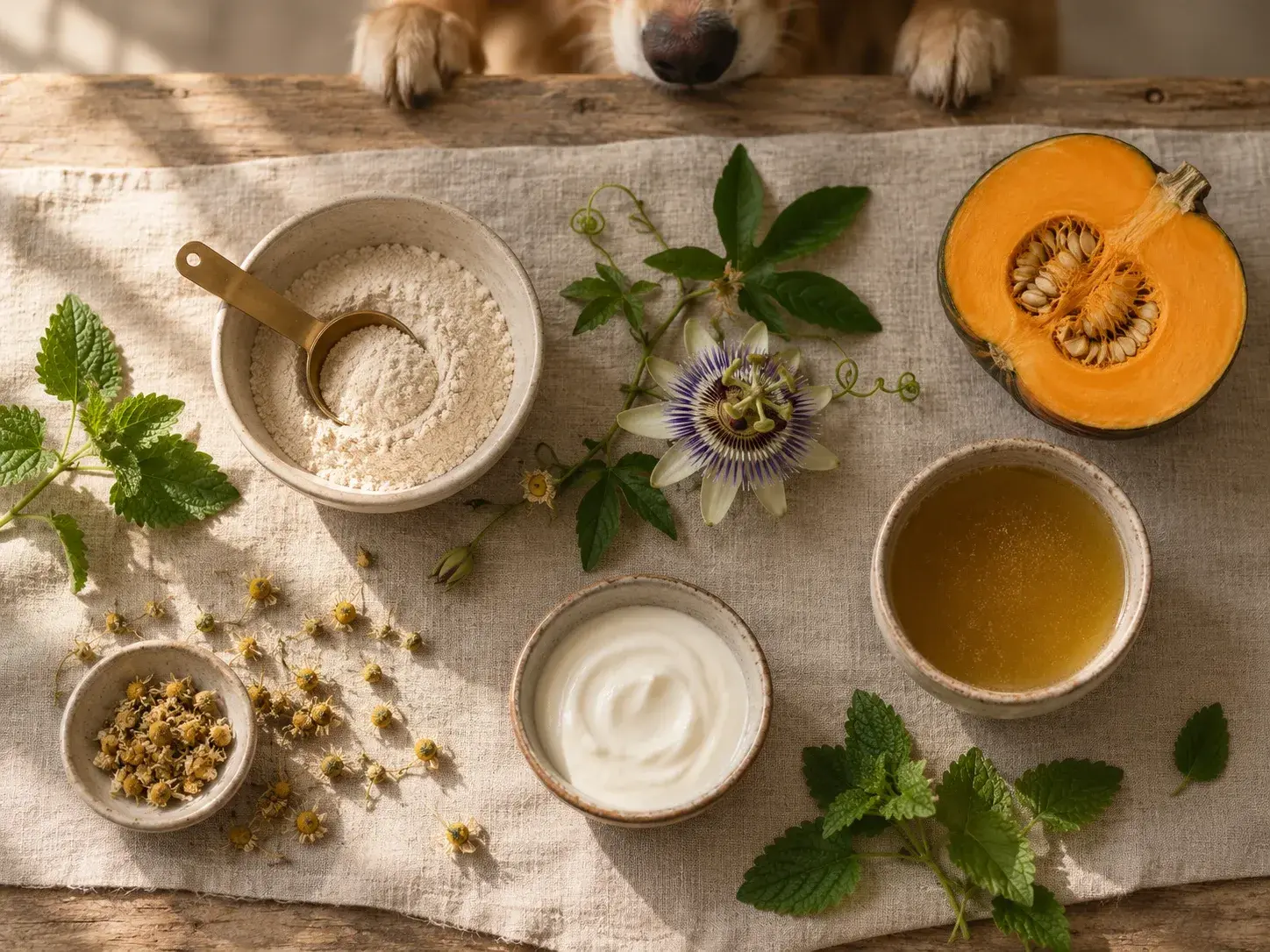
Natural dog supplements are complementary feeds made from botanicals, live cultures or single animal-derived ingredients such as collagen, given alongside a complete diet to support a specific need: digestion, calm, or skin and coat. They are not medicines. In the UK they must comply with feed law, cannot make medicinal claims, and work best when matched to a named problem rather than given as a general top-up.
The short version
- A healthy dog on a complete diet rarely needs a general multivitamin. A supplement earns its place by targeting one issue.
- “Natural” is not a legal category in the UK. Look for named active ingredients, a serving stated by bodyweight, and a registered UK manufacturer.
- Spore-forming Bacillus probiotics are used because they sit inside a protective coat that survives stomach acid. Yoghurt cultures mostly don't.
- Expect two to four weeks of daily use before judging a digestive or calming supplement, and four to eight weeks for coat and joints.
- Anything on prescription medication, pregnant, nursing, still a puppy, or with a diagnosed condition needs a vet's go-ahead first.
What counts as a natural dog supplement in the UK?
A natural dog supplement is a complementary feed built around plant, microbial or animal-derived ingredients rather than synthetic actives, sold to support everyday wellbeing rather than to treat disease. UK law does not define “natural” for pet products, so the word on its own tells you very little.
What does apply is feed law. Dog supplements are regulated as complementary feeds under the feed marketing rules retained from EU Regulation 767/2009, enforced in Great Britain by the Food Standards Agency and local trading standards. Labels must list ingredients and additives accurately and cannot claim to prevent, treat or cure a disease; those claims fall to the Veterinary Medicines Directorate and need a marketing authorisation. In practice, a credible natural supplement names its actives — passionflower, Bacillus subtilis C-3102, dehydrated beef proteins — states a serving by bodyweight, carries a manufacturer registration, and uses “supports” language rather than “treats”.
Does a healthy dog actually need one?
Most healthy adult dogs on a complete commercial food do not need a general supplement, and giving one without a reason can do more harm than good. PDSA's advice on joint supplements is a fair model for the whole category: they “help some dogs, but not all”, and your vet is the right person to ask.
The situations where a targeted natural supplement is reasonable are: loose or unpredictable stools with no diagnosed cause; situational anxiety around fireworks, separation or travel; a dull coat or itchy skin once parasites and allergies have been ruled out; and older dogs slowing down. If the problem is sudden, severe, or comes with weight loss, vomiting or blood, that is a vet visit rather than a supplement.
Probiotic powder vs yoghurt, kefir or bone broth
A dog probiotic delivers named bacterial strains at a stated count. Yoghurt, kefir and bone broth do not. They are foods, and useful ones, but they are not a substitute for a probiotic.
Plain Greek yoghurt and kefir contain Lactobacillus and Bifidobacterium cultures in unstated amounts, and many dogs are lactose-intolerant enough to get looser stools from them, which defeats the purpose. Bone broth contains gelatin and amino acids and encourages drinking — several of our customers add Collagen to the water bowl for exactly that reason — but it has no live cultures at all.
The second question is which type of probiotic. Bacillus species are spore-forming: the bacterium sits inside a tough coat designed to pass through stomach acid and germinate in the gut. That is why they are used in shelf-stable powders like Biome Balance, which carries Bacillus subtilis C-3102 and Bacillus velezensis DSM 15544 at over 525 million live cultures per serving. Conventional Lactobacillus products need refrigeration or protective coatings to achieve the same thing. We explain the difference properly on the probiotics ingredient page.
Natural calming supplement vs vet-prescribed medication
A natural calming supplement is for mild, predictable, situational stress. Prescribed medication is for anxiety that affects a dog's quality of life or safety. They are not interchangeable, and the line is drawn by your vet, not by the label.
Natural calming products typically use botanicals such as passionflower, lemon balm or valerian, or amino acids such as L-tryptophan and L-tyrosine. They are non-sedating and are meant to take the edge off, not switch a dog off. True Calm is passionflower-led; two of our Trustpilot reviewers use it for rescue dogs with separation anxiety and reported improvement, one noting it works best given on the morning meal. If a dog is destructive when left, injures itself, or cannot settle at all, that is beyond what a supplement should be asked to do. A vet or clinical behaviourist can prescribe medication and, more importantly, a behaviour plan; a supplement can sit alongside that plan, not replace it.
How to give a natural supplement, and how long results take
Most natural dog supplements are powders sprinkled on food or stirred into water once a day, served by bodyweight, and need two to four weeks of consistent use before you judge them. Introduce one product at a time.
- Start at half the recommended serving for three or four days, then move to the full amount. This reduces the chance of loose stools while the gut adjusts.
- Give it at the same time each day. For calming products, the morning meal lets the effect build before the day's triggers.
- Keep a simple log: stool quality, scratching, reactivity on walks. Memory is a poor judge of gradual change.
- Review at four weeks. If nothing has changed, stop; do not stack a second product on top hoping for a different result.
All three Frankie & Paws products are sprinkle-on-food powders; Biome Balance can also go straight into water. Every product page shows the serving for each weight band, how many days a pouch lasts and what that works out to per day, so you can judge the real cost before you buy.
Can you combine supplements?
You can usually combine a digestive, a calming and a collagen supplement, because they act on different systems and their actives don't overlap. Combining two products in the same category, or adding a multivitamin on top of a complete food and a supplement, needs a check with your vet.
The risk is rarely the botanicals themselves; it is doubling up on fat-soluble vitamins or minerals across several products. Single-purpose formulas with short ingredient lists make this easy to audit. One thing worth knowing about our own range: True Calm includes brewer's yeast, a natural source of B vitamins, so if your dog already takes a B-vitamin supplement, mention it to your vet. Several of our customers run all three products together across more than one dog; that is a workable combination precisely because none of the three is a multivitamin, but it is their experience, not a study.
Are natural dog supplements safe?
Natural dog supplements are generally safe for healthy adult dogs at the labelled serving, but “natural” does not mean risk-free. The common problems are loose stools during the first week, a reaction to a botanical, and interactions with medication.
Specific cautions worth knowing: passionflower and lemon balm can add to the effect of sedatives and some anxiety medications, and L-tryptophan should be discussed with your vet if your dog takes anything that acts on serotonin. Biome Balance should not be given at the same time as macrolide antibiotics such as erythromycin or azithromycin. Collagen is beef protein, so avoid it in dogs with a beef allergy. Any supplement is inappropriate for a dog with an undiagnosed illness, because it can mask symptoms and delay treatment. Each of our product pages now carries a “who should check with a vet first” answer for that product.
Which natural dog supplements are made in the UK?
UK manufacture matters because the product then falls under Great Britain feed law and trading standards, and because it removes uncertainty about ingredient sourcing. Frankie & Paws supplements are made in Great Britain at a registered feed-manufacturing facility; the registration number, GB 226 0636, is printed on every pouch and shown on every product page alongside the full composition. Whatever brand you buy, a manufacturer registration on the label is the quickest way to check that a product is made by a business the feed authorities know about.
Which supplement is best for gut, anxiety or coat?
The best natural supplement is the one that matches the single problem you are trying to solve: a spore-forming probiotic for loose stools, a botanical calming blend for situational anxiety, and a single-ingredient collagen or omega oil for coat and skin. No one product does all three well, which is why we make three.
For gut: look for named Bacillus strains, a stated CFU count, a prebiotic fibre in the same formula, and no added sugars or fillers. Biome Balance is our most-reviewed product; four of our first seven Trustpilot reviews mention it, and all four report firmer stools or a settled stomach, three of them within two weeks.
For anxiety: passionflower, lemon balm, L-tryptophan or L-tyrosine, non-sedating, given daily rather than only on the day of the trigger. True Calm is the relevant product.
For coat and skin: either a marine omega-3 oil or a dehydrated bovine collagen. Collagen supplies glycine and proline, the amino acids that make up skin and connective tissue; one of our reviewers with four Shar-Peis reported shinier coats and improved skin. Treat coat results as slower, typically four to eight weeks, because hair grows in cycles. Our collagen for dogs guide covers serving and timing in detail.
A note on the evidence
Where this guide quotes customer outcomes, they are individual Trustpilot reviews, quoted as written, not a trial. Where it describes what an ingredient does, it draws on the ingredient's established use in complementary feeds and the pouch labelling, and we have been careful not to claim more than that. The regulatory framing is our understanding of GB feed law as a manufacturer; for anything that touches your own dog's health, your vet's advice outranks ours.
Frequently asked questions
Do dogs on a complete diet need supplements?
Usually not as a general top-up. A complete food is formulated to meet baseline needs, so a supplement only earns its place when there is a specific issue such as loose stools, situational anxiety or a poor coat. Talk to your vet if the problem is new or severe.
How long does a dog probiotic take to work?
Give it daily for at least two weeks before judging, and four weeks to be fair. Several Frankie & Paws Trustpilot reviewers reported firmer stools within two weeks of starting Biome Balance, and one within days. If nothing has changed at four weeks, stop and reassess with your vet.
Is Greek yoghurt a probiotic for dogs?
Only loosely. Plain yoghurt contains live cultures in unstated amounts, and many dogs get looser stools from dairy. A proper probiotic names its strains and CFU count and, in the case of spore-forming Bacillus strains, is built to survive stomach acid.
Can a calming supplement replace anxiety medication?
No. Natural calming supplements suit mild, predictable stress such as fireworks or short separations. Anxiety that affects a dog's safety or quality of life needs a vet or clinical behaviourist, who may prescribe medication alongside a behaviour plan.
Is collagen safe for dogs?
Dehydrated bovine collagen is a plain protein and is well tolerated by most dogs at labelled servings. Avoid it in dogs with a known beef allergy, ask your vet first if your dog is on a protein-restricted diet, and introduce it gradually. Expect coat changes to take four to eight weeks.
Are natural dog supplements regulated in the UK?
Yes, as complementary feeds under feed law, enforced by the Food Standards Agency and local trading standards. They cannot claim to treat or cure disease; those claims require Veterinary Medicines Directorate authorisation. The word natural itself has no legal definition.
Can I give my dog more than one supplement?
Products for different systems, such as a probiotic and a collagen, are usually fine together. Avoid stacking two products in the same category, and check with your vet before adding a multivitamin on top of a complete food and a supplement, since fat-soluble vitamins and minerals can add up.
How much do Frankie & Paws supplements cost per day?
It depends on your dog's weight, because every serving is scaled by weight band. Each product page shows the serving, how many days a pouch lasts and the cost per day for small, medium, large and very large dogs, so you can compare like for like before you buy.
Join the Frankie & Paws Family
Subscribe to our newsletter for research-led wellbeing guides and key ingredient insights, and enjoy 10% off your first purchase.